
The first time most traders open an economic calendar, it looks like a wall of noise — rows of event names, colored flags, three unlabeled numbers per line, and a filter panel with more options than seems necessary. It's genuinely one of the more intimidating tools in forex trading to look at cold, even though the actual concept behind it is simple once broken down.
Here's what every column actually means, which events are worth your attention, and a routine that lets you use a calendar without spending your whole pre-market staring at it.
What an economic calendar actually shows
Strip it down and every economic calendar is really just a list of scheduled data releases and events — interest rate decisions, employment reports, inflation data, and similar — each tied to a specific country, a specific release time, and a rating for how much it typically moves the market. That's it. The intimidating part is usually the density of information on the page, not the underlying idea.
Impact levels: what the colors mean
Most calendars rate each event's expected market impact, usually shown as a color-coded flag or dot:
High impact
Events that regularly cause sharp, fast price moves — interest rate decisions, major employment reports, inflation prints. These are the ones worth actually planning your session around.
Medium impact
Can move the market, especially if the result surprises, but usually with less force and shorter-lived reaction than high-impact events.
Low impact
Rarely moves price on its own. Mostly safe to ignore unless you're trading a very specific, less-followed instrument tied to that release.
Actual, forecast, and previous: the part that actually matters
Every event usually lists three numbers, and this is where most of the real information lives:
- Previous — the result from the last time this data was released.
- Forecast — what economists collectively expect this release to show.
- Actual — the real number, once released.
The number itself rarely moves the market as much as the gap between actual and forecast does. A jobs report that comes in exactly as expected often produces a muted reaction, even if the absolute number sounds strong. A report that badly misses or beats the forecast — even by a modest amount — is what tends to cause the sharp move, because it's the surprise the market is repricing, not the headline figure.

Photo by Viktor Hanaček / picjumbo
The events that actually matter most
Central bank rate announcements (Fed, ECB, BOE, and similar) are consistently among the highest-impact events on any calendar, since interest rates directly affect currency valuation. The accompanying statement or press conference often moves markets as much as the rate decision itself.
The US monthly jobs report, released on the first Friday of most months, is one of the most-watched single events in forex specifically because it feeds directly into expectations about future Fed policy.
The primary inflation measure most traders watch. Since central bank decisions are largely inflation-driven, CPI releases often move markets almost as much as the rate decisions themselves.
GDP shows overall economic growth; PMI (Purchasing Managers' Index) is a faster, more frequent read on economic momentum. Both matter, but generally move markets less sharply than rate decisions or NFP.
A simple routine to avoid overload
You don't need to track every event on the calendar — that's the fastest route back to overwhelmed. A workable routine:
- Filter to High impact only, and only the currencies you actually trade.
- Check once at the start of your session, not continuously throughout it.
- Note the release times for anything high-impact scheduled during your trading window.
- Set an alert rather than watching the clock — let the tool interrupt you at the right moment instead of holding it in your attention the whole session.
Where Overdesk Nexus fits into this
That last step — using alerts instead of watching — is exactly what the calendar overlay in Overdesk Nexus is built for.
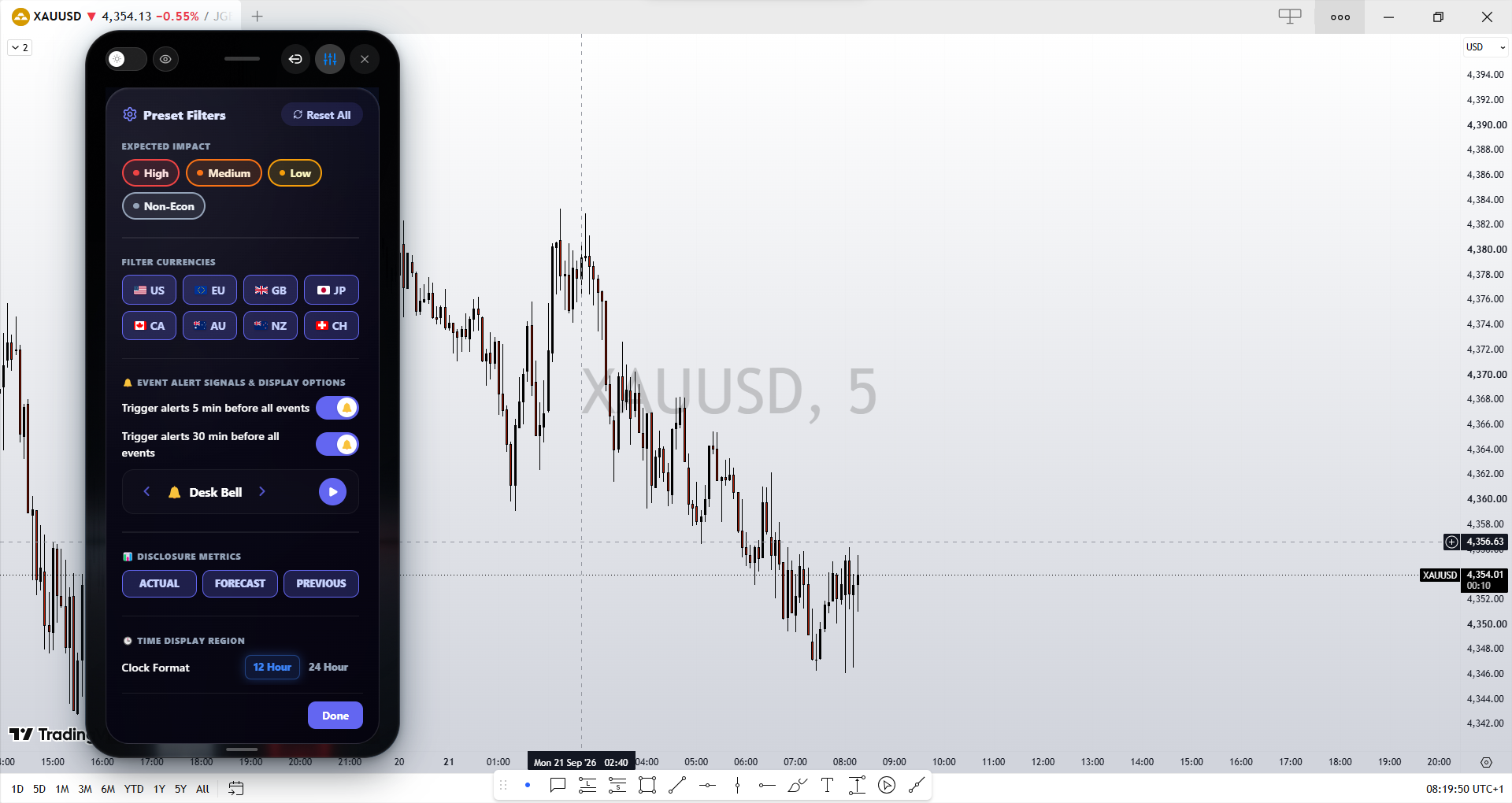
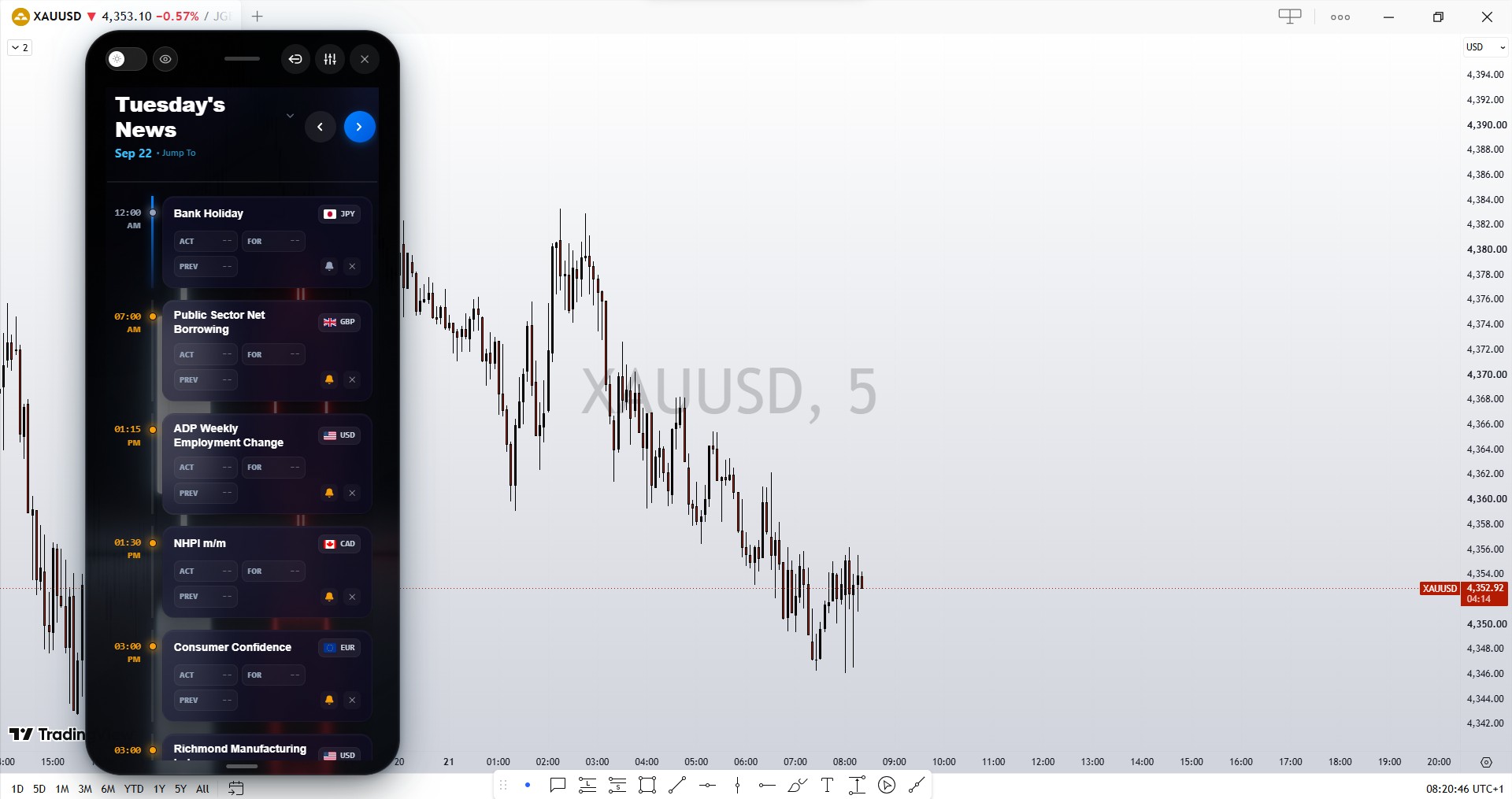
- Filter by High/Medium/Low impact and by currency pair, so you're only seeing what's actually relevant to what you trade.
- Sound alerts 5 and 30 minutes before any event, so you're not manually checking the clock against a release time.
- Runs as a floating overlay on top of your charts, so the calendar and your platform are never a tab-switch apart.
Frequently asked questions
Should I avoid trading during high-impact events entirely?
That depends on your strategy and your firm's rules if you're trading a funded account. Many traders do avoid opening new positions in the minutes around a high-impact release specifically because of the volatility spike; others build strategies around trading that volatility deliberately. Neither is universally right.
Why did the market barely move on a "high impact" event?
Usually because the actual result landed close to the forecast. The impact rating reflects how much an event can move the market on a surprise, not a guarantee that it will every time.
Do I need to check every country's calendar?
No — filter to the currencies in the pairs you actually trade. A EUR/USD trader cares about US and Eurozone events; events tied to currencies you don't trade are just noise.
What's the difference between "actual" being better or worse than forecast?
It depends on the specific data type — a stronger-than-forecast jobs number is typically read as positive for a currency, while a stronger-than-forecast inflation number can be read either way depending on where the central bank's policy stance sits at the time.